
Chesterfield County School District

Excellence in Academics, Arts & Athletics

Nursing Services

Nursing Services

Health and Wellness in Our Schools

At CCSD, the health and safety of our students is our top priority. Our School Nursing Services department is dedicated to bridging the gap between health and learning by providing professional medical care, health education, and a supportive environment for every child.

Our team of licensed school nurses works daily to manage chronic conditions, provide emergency first aid, and monitor public health within our school community. By addressing the physical and emotional well-being of our students, we ensure they are healthy, safe, and ready to achieve their full academic potential.

Any medication to be administered at school, including over the counter, prescription, herbal or homeopathic supplements will require a completed CCSD Medication Permission form completed by an authorized health care provider.


CCSD has full time nurses at all school locations. In the absence of the nurse, staff members who have been trained and documented may administer routine medications, emergency medications, and provide minor first aid according to physicians' orders and district policy. Any special accommodations or treatments will require a signed physician order from. If your child's medical status or contact information changes, it is imperative for you to notify the school nurse immediately and provide the proper documentation. This will ensure safety when providing care for the student at school. All forms can be retrieved from the school nurse as well as in the “Forms and Permissions” section below.


School Nurses

  • In an effort to help protect well children and staff from unnecessary exposure to contagious or infectious diseases, South Carolina requires that children and staff with certain diseases and conditions stay home from school or childcare while contagious.


    If your child feels too sick to go to school or has an illness that can be spread to others, please keep them home from school/childcare and call your health care provider. Consider the following:

    • Does your child’s illness prevent comfortably taking part in activities?

    • Does your child need more care than the staff can give without affecting the health and safety of other children or staff?

    • Could other people get sick from being near your child?

    • If your child has an oral temperature above 100.4 please stay home from work and school. Do not medicate with fever reducing medicine and go to school.

    • If your child has had more than one episode of vomiting or diarrhea, please keep them home.
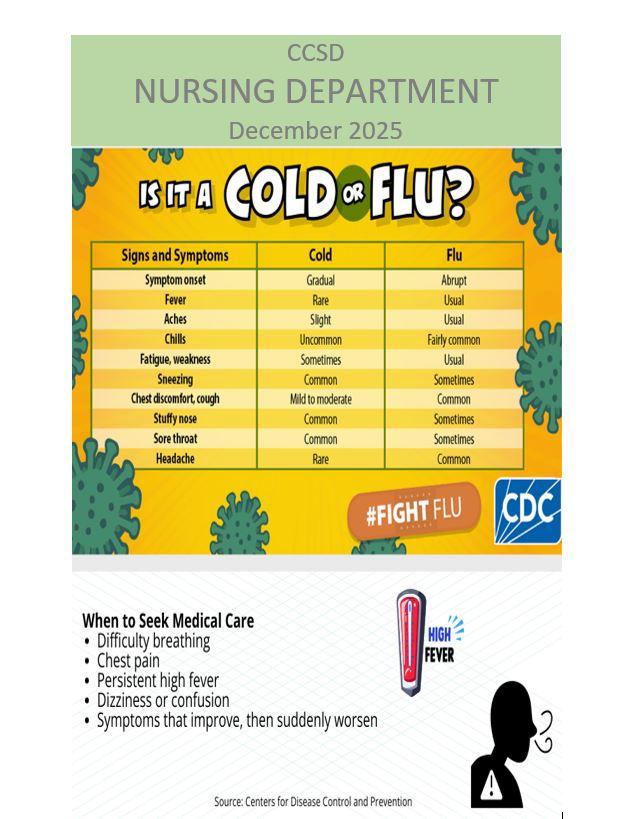
    Is it a cold or Flu

  • Students who come to the health room are assessed and returned to class as soon as possible if no abnormalities are found. Students are encouraged to remain in school unless sick or injured. Students are excluded per the DHEC Exclusion List. Also, as a courtesy, school nurses may notify a parent if your child visits the health room, but unless her assessment reveals that it is an emergency, or your child is ill, this is not a requirement. It is very important to report to your school nurse any illnesses or medical conditions your child has that may require medical support during the school day. If your child experiences an emergency or needs immediate care that cannot be provided at school and a parent cannot be reached, emergency contacts will be notified in your absence.

  • HEAD LICE FACTS

     Head lice are:

    • common among children ages 3-11.

    • not related to cleanliness/good hygiene.

    • spread by extended direct head to head contact, sharing brushes/combs, or sharing head coverings.

    • totally dependent upon a human host to live and typically die within 24 hours without one.

    • not a public health risk, so there is no need to alert parents of lice cases.                                 

    Our district policy:

    • send students home when live lice are found.
    • prohibits readmission to school without proof of treatment.
    • requires an parent/guardian to bring a student to school for a reentry lice check by the school nurse or principal's designee.

    • requires a student returning with living lice, to be sent back home for further treatment.                                  

     It is not our district's practice:

    • to check the heads of all our students in a class or grade. Students are referred for a lice check if there are signs of lice or lice are visible. 

    WHAT PARENTS CAN DO:

    5 EASY STEPS:

    1. Check your student's head periodically for lice.

    2. Treat the lice infestation if found and remove any nits. (remaining nits can hatch and cause reinfestation)

    3. Wash the bedding and clothing items (sheets, pillows, jackets, hats, etc.) in hot water and dry on high heat.

    4. Vacuum soft household surfaces (mattresses, carpets, couch, etc.)

    5. Check family member's hair and treat if indicated.

    6. Retreat affected family members in 7-10 days (per manufacturers' recommendation) in the event any remaining nits have hatched.


    SCDPH Head Lice Information

    SCDPH Head Lice Information for Parents

    How to Examine for Head Lice

  • Immunizations

  • Medications Rules
    ● Medications should be administered by a parent or guardian before or after school hours, when possible.
    ● Initial doses of a medication that a child has never taken before will not be given at school.
    ● In the event of a delayed start to the school day, any morning medication will need to be given at home. This applies to early dismissal as well.
    ● Any medication to be administered at school, including over the counter, prescription, herbal or homeopathic supplements will require a completed CCSD Medication Permission form from an authorized health care provider who is recognized by SC’s Dept. of Labor, Licensing, and Regulation as authorized to prescribe medications. (use a separate form for each medication)
    ● The form must be signed by both physician and parent.
    ● All prescribed medications must have a pharmacy label and must be in the most recent (newest) original labeled container, and cannot be more than a 30 day supply .
    ● The label and the prescriber’s order on the Medication Permission Form must match.
    ● All over the counter medications must be in its original container and unopened.
    ● The school cannot alter dosages without a new medication authorization form.
    ● A parent/guardian must bring the completed Medication Permission Form along with all medications to the school.
    Students are not allowed to transport medication to or from school.
    ● CCSD and its employees reserve the right to refuse to honor medication requests that are not consistent with professional standards and/or deemed unsafe for the school setting. Herbal, homeopathic, food supplements and any other items that do not have FDA approval will not be given at school.
    ● The parent/legal guardian acknowledges that the district and its employees and agents are not liable for any injury arising from administration of medication authorized by an IHP/health care practitioner and/or from a student’s self-monitoring or self-administration of medication. The parent/legal guardian shall indemnify and hold harmless the district and its employees and agents against any claims arising from administration of medication authorized by an IHP/ health care practitioner and/or from a student’s self-monitoring or self-administration of medication.
    ● All medications not picked up within 5 days of termination of treatment or within one day of the last day of school, (unless other arrangements have been made with the school nurse), will be destroyed according to CCSD protocol.
    ● It is the parent/guardian’s responsibility to inform the school of the student’s health condition, medical procedures, medications and any changes throughout the school year.
    ● All forms must be updated annually or when there is any change in medications or medical procedures. 


    SELF-MEDICATING AND/OR SELF-MONITORING (students are not permitted to carry or self administer controlled substances)
    Certain students with special health care needs may carry and/or self administer life saving medications and/or self monitor provided the following requirements are met: 
    1. The CCSD Medication Permission Form is completed with the following: name of the medication/procedure; dosage, time and route of the medication; statement from the legal prescriber that the student may self medicate and/monitor; signature of legal prescriber; signature of parent or legal guardian.
    2. The Self Medicating and/or Self Monitoring Parent/Guardian, Health Care Practitioner and Student form is completed.
    3. Documentation from the student’s healthcare provider stating that the student has been trained and is competent to self- medicate and/or self-monitor.
    4. Medication is provided in an appropriately labeled prescription container.
    5. Determination that the student’s self-administration/monitoring will not jeopardize the safety of the student or others.


    Medication forms can be obtained at your student's school as well as the CCSD website.
     

  • Important tips:

    • School Nurses rarely go on field trips.

    • At least 2 weeks prior to the field trip, notify the school nurse of your child's special health care needs.

    • Complete field trip form.

    • Prescription medication, unless routinely taken during school hours will require a new doctor's permission. Pharmacy labels on medications are not considered Doctor's permission.

    • OTC medication must be in its original container with label intact and have written parent/guardian permission

    • No medication in baggies will be accepted.

    Field trips can be fun for the student but worrisome for the parent if their child has a chronic health condition or takes medication. Typically, the school nurse does not go on field trips, so early planning and meeting with the school nurse/teacher can help alleviate fears and concerns.

    It is important that you fill out the Field Trip Medical Form giving the school as much information as possible even if we know your child has a chronic medical condition, because the teacher will take this form with them on the trip.

    All medication for the field trip must be supplied by the parents. If your child has medication(s) at school that is needed on the field trip, contact the school nurse to make arrangements.  The medication must be in the original pharmacy-labeled or manufacturer-labeled container and only the amount needed for the trip needs to be in the container. No medication in baggies will be accepted.

    If your child requires life-sustaining or emergency medication (insulin, Inhaler, EpiPen, etc.) please inform the nurse to make sure the proper permission forms are signed by the physician so that they can Self-Monitor/ Self-Medicate if possible.

    If your child has an inhaler, insulin injection, or EpiPen in the school’s health room, do not assume it will be sent. It is your responsibility to contact the school nurse/teacher to make arrangements for these to go with your child on the field trip.

  • Certain students with special health care needs may carry and/or self administer life saving medications and/or self monitor provided the following requirements are met:      

    • The CCSD Medication Permission Form is completed with the following: name of the medication/procedure; dosage, time and route of the medication; statement from the legal prescriber that the student may self medicate and/monitor; signature of legal prescriber; signature of parent or legal guardian.

    • The Self Medicating and/or Self Monitoring Parent/Guardian, Health Care Practitioner and Student form is completed.

    • Documentation from the student’s healthcare provider stating that the student has been trained and is competent to self- medicate and/or self-monitor.

    •  Medication is provided in an appropriately labeled prescription container.

    • Determination that the student’s self-administration/monitoring will not jeopardize the safety of the student or others.

    • Students are not permitted to carry or self administer controlled substances

    Self-Monitor/Self-Medicate

    Over the Counter / Prescription Medication Permission Form

  • undefined
  • When to Keep Your Student Home From School

A Memo from the District Nurse


February 3, 2026


Parents/Guardians,


Many of you are aware of the Measles outbreak in South Carolina, with 354 people in quarantine and 22 in isolation. Department of Health (DPH) reports 29 new cases bringing the outbreak total to 876. It is concentrated in the upstate and has made its way to the Columbia area. Data shows that 97% of the people who got measles were unvaccinated. CCSD Nursing Department is working diligently to be prepared if a case should arise within our school district.


Unvaccinated children (including those with Religious, Medical, and 30-Day exemptions) who are exposed to a measles case may need to be excluded from school, sports and afterschool activities for up to 21 days after their last exposure to the positive case, unless they are vaccinated within 72 hours of exposure. Chesterfield County School District will follow SC Department of Health (DPH) guidelines and recommendations for positive cases.


If you have any questions or would like your child to be vaccinated and need assistance finding a provider, please call the school nurse at your child’s school.


Shirlean Johnson, RN

Chesterfield County School District Nursing Services

Measles FAQ's

An informational graphic titled 'Measles FAQ' with questions and answers about the disease.

Forms and Permissions